



Even though our budget for 2026 is still being debated, it’s that time again for the annual budget request. The Trump Administration released the FY2027 budget request in early April, giving us a look into what next year’s spending could look like. As a reminder, the federal government Fiscal Year ends September 30, so FY 2027 will start on October 1, 2026.
The $1.8 trillion request for next year increases defense and IT spending, makes cuts for certain civilian agencies, and proposes agency reorganizations. While the budget is not final and still has a long road before Congress comes to an agreement, this request clearly shows where the administration’s priorities will lie in 2027. In this blog, we’ll cover the 2027 budget request highlights and how contractors could be impacted.
FY 2027 Budget Request at a Glance
Overall, the FY2027 budget request comes out to $1.8 trillion. This includes a $1.15 trillion budget for defense spending and $660 billion for civilian spending, a 10% reduction in non-defense spending.
It’s no surprise that defense spending takes the lion share of the budget. Funding in this area is expected to increase extensively, with a focus on strengthening the U.S. military and expanding the Defense Industrial Base (DIB). Civilian agencies like the IRS, Department of Homeland Security (DHS), and the Small Business Administration (SBA) are facing rather significant cuts, which we'll discuss below.
Defense Spending in the FY2027 Budget Request
Let’s start with the biggest portion of the budget. If you are a contractor in the Defense Industrial Base (DIB), we don’t expect there to be a shortage of opportunities. The White House wants to set aside a $1.1 trillion base and $350 billion mandatory spending totaling $1.5 trillion for 2027. Key areas of the budget request include:
- AI
- Shipbuilding
- Unmanned and Counter Unmanned Aerial Systems
- Missile Defense for the Golden Dome
- Nuclear enterprise for the Department of Defense
- Critical Munitions
- Homeland Security Border
- F-47 Fighter Jet development
Civilian Agency Spending in the FY2027 Budget Request
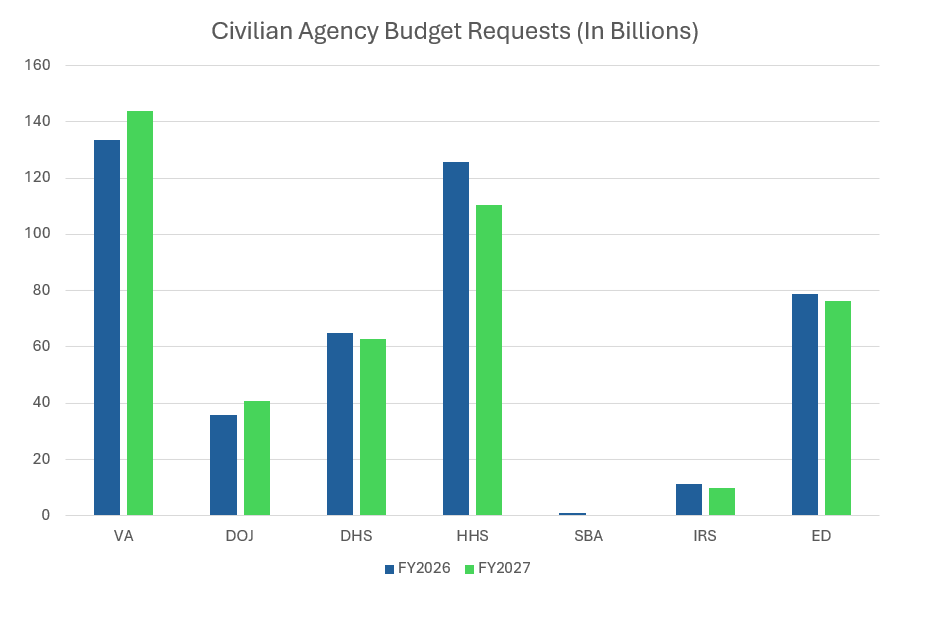
While defense spending grows, non-defense discretionary spending faces some cuts. The FY2027 request proposes roughly a 10% reduction across civilian agencies, with certain departments facing significantly deeper cuts.
Civilian Budget Increases
The top civilian departments in terms of spending are the Department of Veterans Affairs (VA), the Department of Health and Human Services (HHS), and the Department of Education (ED).
The Department of Veterans Affairs (VA) and the Department of Justice (DOJ) were the only two civilian agencies with an increase in budget for FY2027. The VA budget is jumping up $145 million from last year ($144.5B total) with notable spending on medical care, electronic health record modernization, IT systems, AI, and VA construction. Interestingly, the VA will be down in about 30,0000 employees, showing the White House still plans to go through with its reorganization plans across the federal government.
The DOJ request is up $4.7B (totaling $40.8B) from FY 2026, with spending highlighted for the FBI, Drug Enforcement Administration (DEA), prisons, law enforcement, and IT.
Civilian Budget Cuts
On the other side of the coin, top agencies like the Small Business Administration (SBA), IRS, and Department of Homeland Security (DHS) are going to be operating on smaller budgets if this request is passed.
The budget proposes the Small Business Administration (SBA) cut their funding by 67%--major cuts include salaries, entrepreneurial development programs, and business loan program administrative expenses. The veteran support budget will remain consistent with the FY2026 numbers.
The DHS budget is being shifted around to create more funding for ICE and the Secret Service, while cutting spending in subagencies like FEMA and Cybersecurity and Infrastructure Security Agency (CISA). The Trump Administration is proposing a $1.4 billion cut to the IRS, including more cuts to IRS staffing.
Civilian IT Spending
While there are some significant cuts to civilian agencies, the White House plans to increase civilian IT spending in FY2027. The administration wants to set aside $75.7B for federal civilian IT spending, an increase of $7.8B from last year. This is separate from the DoD's IT request. The White House decreased the IT spending in this arena from 2025 to 2026, but they anticipate more of a need as IT modernization efforts continue. On example we have seen with this is GSA's plan to modernize their systems, such as consolidating multiple sites into SAM.gov.
Federal Agency Departmental Shifts
The FY2027 budget request also includes plans for federal agency reorganization. While the Department of Education is mentioned in the FY2027 budget request, Trump still wants to take apart the agency and disperse the core programs to Cabinet agencies.
The White House also wants to combine several agencies under the Administration for a Healthy America (AHA) including the Centers for Disease Control and Prevention, the Substance Abuse and Mental Health Services Administration, the Health Resources and Services Administration and the Office of the Assistant Secretary for Health.
Additionally, the FY2027 budget request reflects the administration’s current plans to privatize airport security by TSA in smaller airports, by cutting funding to the TSA and paring down the workforce. Smaller are proposed to join the Screening Partnership Program in the budget request.
Preparing Your Contract for FY 2027
It may seem early, but Q4 is coming up quickly, and before we know it it’ll be October 1st. If you want to take advantage of the Fy2026 spending spree, now is the time to prepare your contract. And of course, it’s time to start thinking about what shifts the 2027 budget will bring.
While some of these cuts may be discouraging, it’s clear procurement is growing steadily in certain areas such as AI, IT, defense, and specialized vehicles such as OASIS+ and the Multiple Award Schedule (MAS) Program.
If you already have a GSA MAS contract, you should make sure it’s updated, including your pricing and offerings. If you don’t have a contract and are looking to enter the public sector, now is the time to take action. Wherever you are at in your GSA Schedule journey, we are here to help.